About Katie
You do not have to be good.
You do not have to walk on your knees
for a hundred miles through the desert repenting.
You only have to let the soft animal of your body
love what it loves.
-Mary Oliver, Wild Geese
The more I hold space for others in their most trying moments, the more clear it has become to me that so much of our emotional suffering is not individual or pathological, but relational, intergenerational, and profoundly reasonable given the world we are living in. The anxiety, exhaustion, or quiet sense of disorientation that many of us carry — signals that something within us has been working very hard for a very long time, but is no longer working or serving us well.
Through my own experience, clinical work, and ongoing training, I’ve come to understand how the body holds what has not yet had the conditions to be felt, metabolized, or mourned. Losses of things we have already lost, and losses shaped by the fear of what we may still lose. Stress that never fully resolves. Identities shaped by responsibility, creativity, caretaking, or performance, where worth becomes entangled with output or endurance.
These patterns are not failures of resilience. They are adaptations to systems, relationships, and conditions that often ask too much while offering too little space to process what has been lost.
This work is, in many ways, an act of resistance — against the pace that asks us to optimize rather than feel, and against the systems that have only ever valued the parts of us that produce, perform, or endure.
I believe healing happens when we finally make enough space for all of ourselves, not just the parts that are useful. When we return to the animal part of the body that loves what it loves (to borrow from Mary Oliver), and remember what rest truly feels like. When we find rest for its own sake, not simply to recover enough to return to the grind. When we find a slowness that honors a sense of worth that exists without needing to first justify or prove itself — this is when we can find our place again in the natural world.
That coming home to ourselves, in the natural order of things, and the whole, unglamorous, slow process of it, is where I've seen the most profound change happen.
This is why I do this work.
If something resonates here, I’d love to hear from you.

About Me
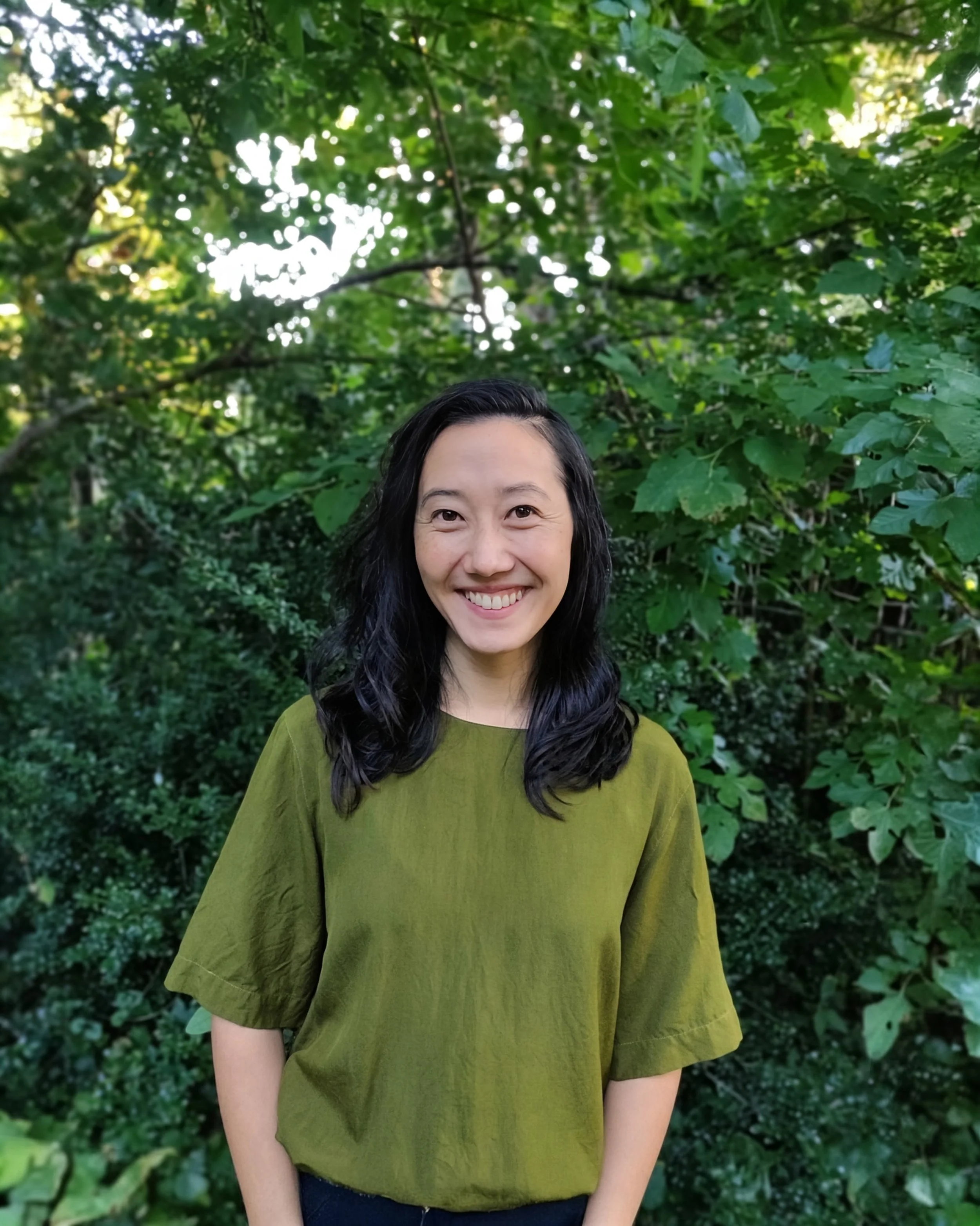
Welcome — I’m Katie (she/her), a biracial, second-generation, cisgender psychotherapist and Licensed Clinical Professional Counselor (LCPC) based in Maryland. I live in Baltimore City, a place that has deeply shaped me over the past decade, though I spent my formative years in the Midwest.
Before becoming a therapist, I spent many years in the performing and visual arts. That world shaped how I listen, how I notice subtle shifts, and how deeply I value creativity, honesty, presence, and collaboration. Over time, that path meandered and led me into the wellness field, and eventually into therapy — work that still feels rooted in relationship, attunement, and making space for what’s often hard to name — I just use a different medium now.
In my experience, healing happens in relationship — not just in insight, but in being met slowly and honestly over time. Much of my work is about creating a space where people can pause, feel into themselves, and begin to untangle patterns that no longer fit. From there, clarity tends to emerge naturally: about boundaries, connection, grief, desire, and how to stay in relationship with oneself and others during periods of change.
I received a master’s degree in Clinical Professional Counseling from Loyola University Maryland. Additional training includes certification in Nature Informed Therapy, an externship in Emotionally Focused Therapy (EFT), and ongoing study in Somatic Experiencing® at the Intermediate level. These frameworks support the way I already work — with attention to the body, the nervous system, and the larger contexts (relational, ecological, cultural) that shape our inner lives.
I’m especially drawn to working with people who feel deeply, think creatively, and have a complicated, sometimes tangled relationship with these aspects of themselves and the roles and identities they hold.

Life in nature expresses itself through myriad variations: intensity, dormancy, growth, decay, seasons, climates, and changing shapes, textures, and dimensions. Nature inherently meets and moves toward the prevailing conditions in each moment.
-Rochelle Calvert

Over time, and as I’ve dealt with my own losses and chronic illness, I’ve come to learn that much of what we struggle with as human beings has something to do with loss—sometimes clear and named, and sometimes diffuse, unfinished, or hard to locate. There are experiences that might arrive too quickly to be understood, moments when something meaningful disappears before we have the chance to fully notice or make sense of what has changed. There are also quieter losses: the gradual narrowing of possibility, unexpected limitations that we never thought we’d have, the holding back from wanting after losing so much, or the constant scanning for what might go wrong next. These losses are harder to talk about — often because they are so subtle they can go on unseen for quite some time, or because we might not have the foundational language to even begin the conversation.
When these losses remain unacknowledged, these experiences often instead show up as anxiety, low mood, numbness, or overwhelm. Not because something is wrong, but because the body and nervous system are responding to what has been lost, threatened, or left unresolved. In this way, grief isn’t always something we know we’re feeling—it’s something we carry, something that lives in sensation, posture, breath, and pacing, waiting for enough safety and space to be met.
I care deeply about working with grief because for a long time, I was grieving without having language for what was happening to me. Before I had words or space to practice grief, my pain felt isolating and shame-filled. As I began to name grief—and to understand that life itself is an ongoing relationship with loss—something shifted. My pain softened. I felt less alone. Healing became possible.
Grief: my lens
I understand grief as both deeply human, and deeply communal —and therefore somatic. We are animals with bodies, and tangible loss is viscerally disruptive. When something or someone exists in one moment and is gone the next, the nervous system struggles to make sense of it. Even when losses are harder to name—unfolding slowly, ambiguously, or collectively—we can feel them. Ecological, financial, and sociopolitical systems that once felt stable are changing and shifting—some crumbling before our very eyes—and the body often responds before the mind can catch up.
For a long time, many of us have been asked to move quickly through these experiences—to stay functional, productive, and composed. But grief does not move at the pace of efficiency. It requires slowness, space, and the presence of others. In my experience, carrying grief without language can be deeply lonely, while having it met with steadiness and respect for the body’s timing can be profoundly relieving.
If you are exhausted but still functioning, grieving without clear words, or doing your best to participate in a world that feels increasingly heavy—this makes sense.

Training and Education
Master of Science, Clinical Professional Counseling, Loyola University Maryland
Bachelor of Arts, Journalism, Minor in Sociology, Northern Illinois University
Somatic Experiencing: Beginning I, II, III (Somatic Experiencing International, Maureen Gallagher)
Emotion Focused Therapy: Externship in Emotionally Focused Couples Therapy (Philadelphia Center for Emotionally Focused Therapy), EFIT Essentials (ICEEFT Courses with Senem Zeytinoğlu Saydam and Ali Barbosa), Working with Ambivalence (The Washington Baltimore Community for EFT)
Nature Informed Therapy Certificate, Center for Nature Informed Therapy
Additional training/experience: Entering the Healing Ground: Grief Ritual Leadership Training Program, Led by Francis Weller, Erin Geesaman Rabke, Holly Truhlar, Carl Rabke, and Alexandre Jodun
Values I hold
Authenticity
I value honesty over polish. I’m more interested in what is real than in what looks coherent or resolved. I don’t expect clarity, consistency, or insight to arrive immediately or on demand, and I trust that what is messy or unfinished often carries the most important lesson.
Humanity
I value moments of lightness, humor, and shared humanity while at the same time, holding seriousness and pain. I don’t believe grief or difficulty require solemnity at all times. Aliveness, laughter, and tenderness can and often must coexist with sorrow. These moments often show us what is truly meaningful to us.
Truth
I value truth that is lived and felt, not forced or rushed. I am attentive to emotional truth, bodily truth, and the truth of limits—personal, relational, and systemic. I am less interested in quick answers than I am in listening for what is actually present.
Slowness
I value slowness as a necessary response to the pace of modern life. I don’t experience slowness as avoidance or stagnation, but as a way of staying in relationship with the moment in time, and with the present experience long enough for true meaning and integration to emerge.